
RN · Rassemblement national Bloc: Rassemblement national et alliés
In the same bloc
Other candidates of the “Rassemblement national et alliés” bloc, with their current score.
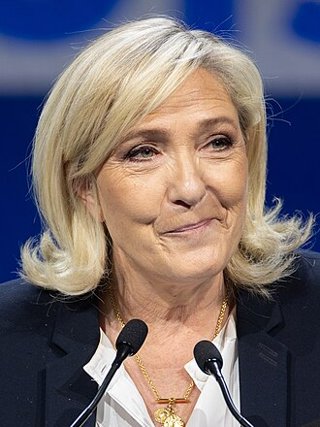 Marine Le Pen
RN 35.7%
Profile
Experimental · automatically generated (local model) from Wikipedia and the press — may contain errors.
Jordan Bardella, born in 1995, has been the president of the National Rally since 2021 and is a Member of the European Parliament. He is identified as a potential or probable candidate for the 2027 presidential election, succeeding Marine Le Pen as party leader. His political trajectory is marked by rapid advancement within the National Rally and constant media visibility.
Strengths
- He assumed the presidency of the National Rally in 2021, consolidating his status as Marine Le Pen's heir apparent. Wikipédia
- According to Nice-Matin, he enjoys strong local popularity, illustrated by gatherings described as 'crowd baths' in territories considered secure. Nice-Matin · 31 Oct 2026
- He maintains an active media and political presence, notably through book signings and regular trips, such as the one planned for Hénin-Beaumont. HorizonActu.fr · 31 Oct 2026
Weaknesses
- According to L'Opinion, he faces internal doubts regarding the weakness of his entourage, his authority, and his ability to broaden the electorate. L'Opinion Centre-right · 23 Oct 2026
- Investigations by Mediapart, relayed by Orange Actualités and L'Opinion, revealed antisemitic writings attributed to Jordan Bardella, sparking criticism over the lack of political consequences. Orange Actualités · 30 Oct 2026 ; L'Opinion Centre-right · 24 Oct 2026
- His image is regularly challenged by controversies over his lifestyle, particularly concerning a luxury watch, and by hostile slogans that went viral during demonstrations. 20 Minutes · 31 Oct 2026 ; Marie France, magazine féminin · 31 Oct 2026 ; Gentside · 29 Oct 2026
Text from Wikipedia (CC BY-SA 4.0)
Polls and trend
Dots: one first-round poll. Line: model average. Band: 80% interval.
How to read this chart. Each dot is a published poll (pollster, end date of fieldwork); the line joins the average score estimated by the model. Hover over a dot to see the pollster and sample size.
Learn more
Polls from different pollsters are not directly comparable: each has its own method and usual bias, which the model corrects in part. The spread between dots on the same day reflects this diversity as much as statistical uncertainty.
View the figures as a table
| Date | Pollster | 1st-round score | n = |
|---|---|---|---|
| 9 Dec 2024 | Ifop | 34.0% | 1101 |
| 12 Sep 2024 | OpinionWay | 35.0% | 1009 |
| 18 Apr 2024 | Ifop | 33.0% | 1090 |
| 18 Apr 2024 | Ifop | 30.0% | 1090 |
| 10 Jan 2024 | Ifop | 27.0% | 1144 |
| 10 Jan 2024 | Ifop | 28.0% | 1144 |
| 13 Apr 2023 | OpinionWay | 23.0% | 1038 |
Probability of winning, day by day
Line: main scenario. Band: spread across poll scenarios (min–max).
Reconstructed curve: the model replayed day by day on the polls already published. Days without a recent poll are missing.
How to read this chart. The line is the candidate's probability of winning over time, the band its uncertainty interval. It is reconstructed day by day on the polls already published.
Learn more
A falling probability does not say the candidate is "losing": it says that, given the known polls, a smaller share of simulations has them winning. The model knows neither manifestos nor events, only the numbers.
In the press
What newspapers write is not voter support. None of these figures enters the probability.
How to read this table. The list shows recent articles in which the candidate is mentioned, with headline, outlet and date. Each headline links to the original article.
Learn more
The number of mentions measures press attention, not opinion: an article may be favourable, critical or purely factual, and the site does not judge. The outlets tracked cover the whole spectrum; their list is on the "Press" page.
Mentions : 23
- Jordan Bardella de retour à La Seyne dans une semaine : bain de foule et test de popularité en terrain conquis - Nice-Matin Nice-Matin · 31 Oct 2026
- « Une République islamique en miniature » : le RN réitère les propos passés de Jordan Bardella sur Trappes Le Parisien · 31 Oct 2026
- Hénin-Beaumont. Jordan Bardella attendu le 5 novembre pour une séance de dédicaces - HorizonActu.fr HorizonActu.fr · 31 Oct 2026
- « On fait caca sur Bardella »… Comment ce slogan de manif est devenu viral - 20 Minutes 20 Minutes · 31 Oct 2026
- Jordan Bardella a-t-il vraiment retiré une montre de luxe de son poignet alors qu’il prenait la parole au congrès du RN ? Le Parisien · 31 Oct 2026
- Les révélations de Mediapart n'ont pas empêché la réélection triomphale de Jordan Bardella à la tête du RN. Yaël Goosz analyse les ressorts de cette apparente résistance aux polémiques. ➡️https://l.franceinter.fr/jts - Facebook Facebook · 31 Oct 2026
- Combien gagne Jordan Bardella ? - Le Quotidien de l'Entreprise Le Quotidien de l'Entreprise · 31 Oct 2026
- France Inter. . Les révélations de Mediapart n'ont pas empêché la réélection triomphale de Jordan Bardella à la tête du RN. Yaël Goosz analyse les ressorts de cette apparente résistance aux polémiques. ➡️https://l.franceinter.fr/jts - Facebook Facebook · 31 Oct 2026
What the markets say
No market quotes this candidate.